
 Image 1 of 1
The Ultimate ADHD Kids Bundle
The Ultimate ADHD Kids Bundle
Everything you need to investigate, understand, and support your child's ADHD - in one place.
Who this is for:
Parents whose child has recently received an ADHD diagnosis and want to understand what's driving it
Parents who suspect ADHD but haven't had answers
Parents whose child has been on the ADHD path for years but still isn't thriving
Anyone who wants to look beyond symptom management and into root causes
What's inside — 11 expert-designed resources
1. ADHD Testing Support: Blood Testing Guide for Parents
Standard blood results flagged as "normal" frequently miss the functional deficiencies driving ADHD symptoms.
This guide covers every key test such as:
iron studies and ferritin
plasma zinc
RBC magnesium
vitamin D
B vitamins
Homocysteine
full thyroid panel
fasting glucose and insulin
omega-3 index.
Outlining OPTIMAL functional ranges used in integrative practice alongside the conventional lab ranges, and exactly why the gap between the two matters.
Includes a word-for-word GP script to take to your next appointment, a priority order if budget is limited, and Australian private pathology options if your GP won't order them.
2. ADHD Support Supplement Protocol: A Tiered, Start-Here Guide
A sequenced three-tier protocol covering what to take, what dose, what form, and when — based on your child's weight and age.
Tier 1 covers magnesium glycinate and omega-3.
Tier 2 adds zinc and activated B vitamins.
Tier 3 covers iron and vitamin D3/K2 - testing-guided only.
Herbal medicine add-ons are also covered: Bacopa, lemon balm, passionflower, oat straw, and saffron — with paediatric dosing, forms, and clinical notes for each.
Includes a supplement label checklist — what to look for and what to avoid in every product you buy.
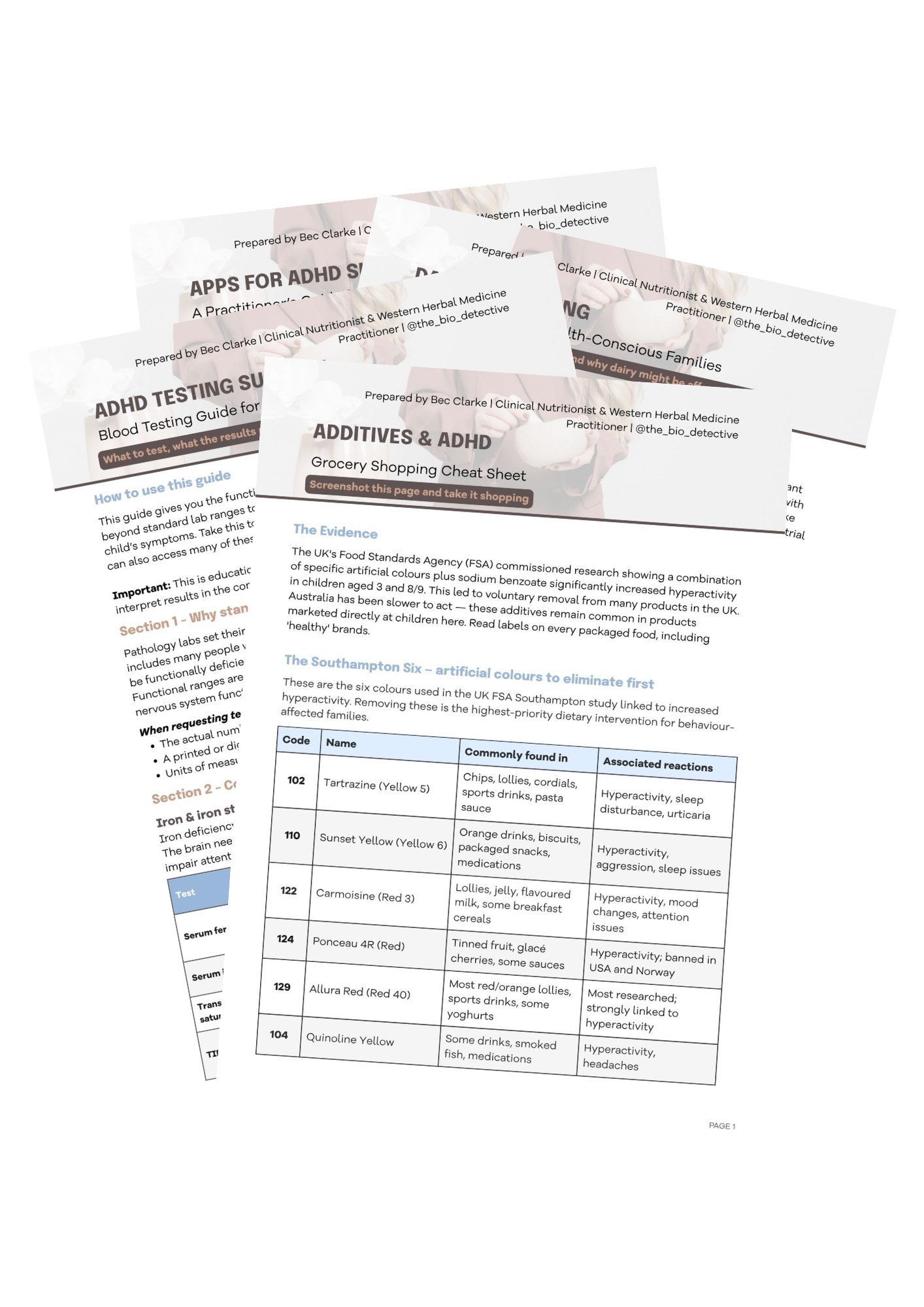
3. Additives & ADHD: Grocery Shopping Cheat Sheet
The Southampton Six artificial colours - 102, 110, 122, 124, 129, 104 - are still permitted in Australian food products marketed directly at children, despite UK research linking them to increased hyperactivity.
This guide covers every additive code linked to behaviour and attention, the specific products they hide in, the preservatives and glutamates to watch for, and a direct swap list of cleaner Australian alternatives.
Designed to be screenshot and taken shopping.
4. Dairy-Free Living: Practical Swaps for Health-Conscious Families
Casein and gluten can produce opioid-like peptides (casomorphins and gliadorphins) in children with increased gut permeability, directly blunting executive function and increasing hyperactivity - measurable via urine peptide testing.
A 4-week dairy-free trial is one of the most clinically useful first steps in any integrative ADHD protocol.
This guide covers:
signs dairy may be contributing to your child's symptoms
a comprehensive Australian brand swap guide across yoghurt, milk, cheese, butter, ice cream, and chocolate
hidden dairy names on labels
the nutrients to monitor and replace during a dairy trial.
5. Gluten-Free Living Guide
Gliadorphins from gluten breakdown can act on opioid receptors in children with leaky gut, with direct effects on behaviour, focus, and mood.
For children with suspected gut permeability, coeliac risk, or confirmed gluten sensitivity, dietary modification is a primary intervention — not an afterthought.
This guide covers the clinical rationale for a gluten trial in ADHD presentations, practical Australian brand alternatives across every food category, hidden gluten sources, label reading guidance, and the nutritional gaps to address when removing gluten from a child's diet.
6. Gut-Brain Health Protocol: Supporting ADHD Through the Microbiome
Children with ADHD consistently show distinct microbiome profiles compared to neurotypical peers.
This protocol covers the gut-brain connection in plain language, a symptom checklist to identify whether gut dysbiosis is likely contributing, and a four-step protocol:
remove the disruptors
feed beneficial bacteria with prebiotic foods ranked by kid-friendliness
targeted probiotic supplementation by strain and indication
support for bowel regularity.
Includes a fermented food introduction guide for children and specific probiotic strains with paediatric dosing.
7. Mould, Biotoxins & ADHD: What Parents Need to Know
This is the most overlooked root cause in paediatric ADHD presentations.
Approximately 25% of people carry an HLA-DR genetic variant that prevents normal biotoxin clearance - meaning mycotoxins from water-damaged buildings recirculate and accumulate, driving neuroinflammation in the exact brain regions responsible for attention, impulse control, and emotional regulation.
This guide covers:
how mycotoxins disrupt dopamine, serotonin, cortisol, and the blood-brain barrier
a full symptom checklist across cognitive, mood, and physical domains
what to look for in the home and at school
environmental and clinical testing options available in Australia
a seven-step action framework (remove, filter, bind, repair, nourish, support)
diet during mould illness recovery
when to seek specialist support.
The key diagnostic clue: symptoms that are consistently worse at home or school than elsewhere - especially improving significantly during school holidays or time away from the building - is one of the most reliable clinical indicators of environmental biotoxin illness.
8. High-Protein Focus Recipes: For Families Supporting ADHD Naturally
Blood sugar instability is one of the most underappreciated drivers of ADHD symptom severity.
A high-sugar, low-protein breakfast produces a glucose spike followed by a crash within 2–3 hours - consistently timed with peak teacher-reported attention and behaviour difficulties.
This guide targets:
15g+ protein at breakfast and 10g+ at every subsequent meal and snack.
Includes batch-cook breakfast recipes (savoury egg muffins, collagen chia pudding, savoury oat porridge)
a lunchbox template with protein anchor, healthy fat, fibre, and low-sugar carb categories
specific lunchbox recipes (tuna pinwheels, mini frittata squares)
snack recipes (hidden veggie protein balls)
a snack swap cheat sheet with protein counts.
All recipes are nut-free by default or include nut-free swaps.
9. Food, Mood & Focus Diary: One Week Tracker
A structured seven-day tracking tool that records every meal and drink, focus rating (1–5), mood and behaviour observations, sleep data, and supplement timing — with a weekly reflection page and practitioner-ready summary.
Patterns identified through consistent tracking - sugar crashes, morning vs afternoon windows, specific food triggers - provide the most useful clinical data for tailoring an individual protocol.
Bring this completed to your next appointment.
10. Apps for ADHD Support: A Practitioner's Guide for Parents
A vetted, categorised app guide covering:
mindfulness and nervous system regulation such (Smiling Mind, Calm)
focus and task management (Forest, Tiimo, Goblin Tools)
sleep and wind-down (Moshi, Insight Timer)
movement and sensory regulation (GoNoodle)
parent support tools.
Each app includes the ADHD-specific rationale for why it works neurologically.
Also covers the dopamine paradox of using screens to manage ADHD, and practical boundaries for screen use that don't create a dopamine whiplash cycle.
11. Somatic & Limbic System Training Guide for Kids
In children who have experienced chronic illness - including mould exposure, gut dysbiosis, or recurrent infections - the limbic system can become locked in a state of hyperarousal, constantly scanning for threat.
This presents as emotional dysregulation, sensory sensitivities, sleep-onset difficulty, impulsivity, and anxiety - all of which overlap directly with ADHD.
This guide covers eight specific somatic and breathing practices with clinical notes on why each works neurologically, how and when to use them, and how to build them into a daily rhythm.
Designed for ages 3–10.
Includes the parent's role in co-regulation - the most powerful nervous system intervention available for any child.
Why these resources work together
Each resource in this bundle targets a different potential root cause or supporting system.
Used together, they create a comprehensive foundation across environment, nutrition, gut health, blood chemistry, diet, and nervous system function — the areas that are almost never investigated when a child receives an ADHD diagnosis through the standard pathway.
No single resource is a treatment.
All are designed to be used alongside - not instead of - qualified practitioner support.
What they give you is the knowledge and tools to ask better questions, run the right tests and make informed dietary changes.
Prepared by Bec Clarke | Clinical Nutritionist & Integrative Health Practitioner | @the_bio_detective
All resources are for educational purposes only and do not constitute personalised medical advice. Individual responses vary. Work with a qualified practitioner to tailor recommendations to your child's specific presentation.
The Ultimate ADHD Kids Bundle
Everything you need to investigate, understand, and support your child's ADHD - in one place.
Who this is for:
Parents whose child has recently received an ADHD diagnosis and want to understand what's driving it
Parents who suspect ADHD but haven't had answers
Parents whose child has been on the ADHD path for years but still isn't thriving
Anyone who wants to look beyond symptom management and into root causes
What's inside — 11 expert-designed resources
1. ADHD Testing Support: Blood Testing Guide for Parents
Standard blood results flagged as "normal" frequently miss the functional deficiencies driving ADHD symptoms.
This guide covers every key test such as:
iron studies and ferritin
plasma zinc
RBC magnesium
vitamin D
B vitamins
Homocysteine
full thyroid panel
fasting glucose and insulin
omega-3 index.
Outlining OPTIMAL functional ranges used in integrative practice alongside the conventional lab ranges, and exactly why the gap between the two matters.
Includes a word-for-word GP script to take to your next appointment, a priority order if budget is limited, and Australian private pathology options if your GP won't order them.
2. ADHD Support Supplement Protocol: A Tiered, Start-Here Guide
A sequenced three-tier protocol covering what to take, what dose, what form, and when — based on your child's weight and age.
Tier 1 covers magnesium glycinate and omega-3.
Tier 2 adds zinc and activated B vitamins.
Tier 3 covers iron and vitamin D3/K2 - testing-guided only.
Herbal medicine add-ons are also covered: Bacopa, lemon balm, passionflower, oat straw, and saffron — with paediatric dosing, forms, and clinical notes for each.
Includes a supplement label checklist — what to look for and what to avoid in every product you buy.
3. Additives & ADHD: Grocery Shopping Cheat Sheet
The Southampton Six artificial colours - 102, 110, 122, 124, 129, 104 - are still permitted in Australian food products marketed directly at children, despite UK research linking them to increased hyperactivity.
This guide covers every additive code linked to behaviour and attention, the specific products they hide in, the preservatives and glutamates to watch for, and a direct swap list of cleaner Australian alternatives.
Designed to be screenshot and taken shopping.
4. Dairy-Free Living: Practical Swaps for Health-Conscious Families
Casein and gluten can produce opioid-like peptides (casomorphins and gliadorphins) in children with increased gut permeability, directly blunting executive function and increasing hyperactivity - measurable via urine peptide testing.
A 4-week dairy-free trial is one of the most clinically useful first steps in any integrative ADHD protocol.
This guide covers:
signs dairy may be contributing to your child's symptoms
a comprehensive Australian brand swap guide across yoghurt, milk, cheese, butter, ice cream, and chocolate
hidden dairy names on labels
the nutrients to monitor and replace during a dairy trial.
5. Gluten-Free Living Guide
Gliadorphins from gluten breakdown can act on opioid receptors in children with leaky gut, with direct effects on behaviour, focus, and mood.
For children with suspected gut permeability, coeliac risk, or confirmed gluten sensitivity, dietary modification is a primary intervention — not an afterthought.
This guide covers the clinical rationale for a gluten trial in ADHD presentations, practical Australian brand alternatives across every food category, hidden gluten sources, label reading guidance, and the nutritional gaps to address when removing gluten from a child's diet.
6. Gut-Brain Health Protocol: Supporting ADHD Through the Microbiome
Children with ADHD consistently show distinct microbiome profiles compared to neurotypical peers.
This protocol covers the gut-brain connection in plain language, a symptom checklist to identify whether gut dysbiosis is likely contributing, and a four-step protocol:
remove the disruptors
feed beneficial bacteria with prebiotic foods ranked by kid-friendliness
targeted probiotic supplementation by strain and indication
support for bowel regularity.
Includes a fermented food introduction guide for children and specific probiotic strains with paediatric dosing.
7. Mould, Biotoxins & ADHD: What Parents Need to Know
This is the most overlooked root cause in paediatric ADHD presentations.
Approximately 25% of people carry an HLA-DR genetic variant that prevents normal biotoxin clearance - meaning mycotoxins from water-damaged buildings recirculate and accumulate, driving neuroinflammation in the exact brain regions responsible for attention, impulse control, and emotional regulation.
This guide covers:
how mycotoxins disrupt dopamine, serotonin, cortisol, and the blood-brain barrier
a full symptom checklist across cognitive, mood, and physical domains
what to look for in the home and at school
environmental and clinical testing options available in Australia
a seven-step action framework (remove, filter, bind, repair, nourish, support)
diet during mould illness recovery
when to seek specialist support.
The key diagnostic clue: symptoms that are consistently worse at home or school than elsewhere - especially improving significantly during school holidays or time away from the building - is one of the most reliable clinical indicators of environmental biotoxin illness.
8. High-Protein Focus Recipes: For Families Supporting ADHD Naturally
Blood sugar instability is one of the most underappreciated drivers of ADHD symptom severity.
A high-sugar, low-protein breakfast produces a glucose spike followed by a crash within 2–3 hours - consistently timed with peak teacher-reported attention and behaviour difficulties.
This guide targets:
15g+ protein at breakfast and 10g+ at every subsequent meal and snack.
Includes batch-cook breakfast recipes (savoury egg muffins, collagen chia pudding, savoury oat porridge)
a lunchbox template with protein anchor, healthy fat, fibre, and low-sugar carb categories
specific lunchbox recipes (tuna pinwheels, mini frittata squares)
snack recipes (hidden veggie protein balls)
a snack swap cheat sheet with protein counts.
All recipes are nut-free by default or include nut-free swaps.
9. Food, Mood & Focus Diary: One Week Tracker
A structured seven-day tracking tool that records every meal and drink, focus rating (1–5), mood and behaviour observations, sleep data, and supplement timing — with a weekly reflection page and practitioner-ready summary.
Patterns identified through consistent tracking - sugar crashes, morning vs afternoon windows, specific food triggers - provide the most useful clinical data for tailoring an individual protocol.
Bring this completed to your next appointment.
10. Apps for ADHD Support: A Practitioner's Guide for Parents
A vetted, categorised app guide covering:
mindfulness and nervous system regulation such (Smiling Mind, Calm)
focus and task management (Forest, Tiimo, Goblin Tools)
sleep and wind-down (Moshi, Insight Timer)
movement and sensory regulation (GoNoodle)
parent support tools.
Each app includes the ADHD-specific rationale for why it works neurologically.
Also covers the dopamine paradox of using screens to manage ADHD, and practical boundaries for screen use that don't create a dopamine whiplash cycle.
11. Somatic & Limbic System Training Guide for Kids
In children who have experienced chronic illness - including mould exposure, gut dysbiosis, or recurrent infections - the limbic system can become locked in a state of hyperarousal, constantly scanning for threat.
This presents as emotional dysregulation, sensory sensitivities, sleep-onset difficulty, impulsivity, and anxiety - all of which overlap directly with ADHD.
This guide covers eight specific somatic and breathing practices with clinical notes on why each works neurologically, how and when to use them, and how to build them into a daily rhythm.
Designed for ages 3–10.
Includes the parent's role in co-regulation - the most powerful nervous system intervention available for any child.
Why these resources work together
Each resource in this bundle targets a different potential root cause or supporting system.
Used together, they create a comprehensive foundation across environment, nutrition, gut health, blood chemistry, diet, and nervous system function — the areas that are almost never investigated when a child receives an ADHD diagnosis through the standard pathway.
No single resource is a treatment.
All are designed to be used alongside - not instead of - qualified practitioner support.
What they give you is the knowledge and tools to ask better questions, run the right tests and make informed dietary changes.
Prepared by Bec Clarke | Clinical Nutritionist & Integrative Health Practitioner | @the_bio_detective
All resources are for educational purposes only and do not constitute personalised medical advice. Individual responses vary. Work with a qualified practitioner to tailor recommendations to your child's specific presentation.